
|
 Centre for Addiction Centre for Addictionand Mental Health Please note: This is the very old CAMH website from 2012, made available for legacy purposes. |
|
|
|
Queen Street Redevelopment
|
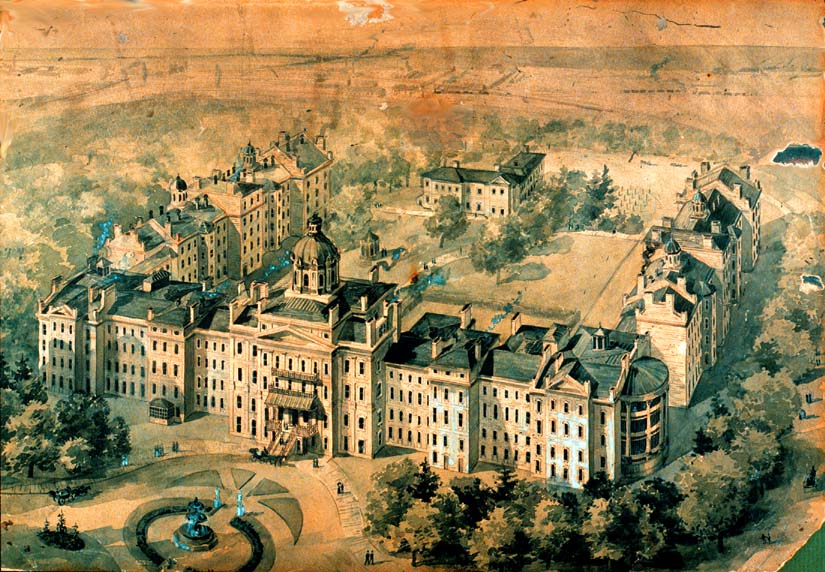
The 1800s - History of CAMH and the Queen Street SiteIn 1846, construction began on the first ‘Provincial Lunatic Asylum’ on a 50 acre portion of the Garrison Reserve, which was Military property. Designed by architect John George Howard, it was the largest and most modern building in British North America at the time; with its own 12,000 gallon fresh water tank, flush toilets, and central heating.
A watercolour painting of Upper Canada's "Provincial Lunatic Asylum", designed by architect John Howard, as it would have appeared in the 19th Century. Painting, circa 1890s by W.G. Thomson. This and other historic images are from the CAMH Archives except where noted.
The 40 foot diameter dome was the highest point in Toronto. It was capped by a cupola as a lookout guarding against potentially renewed attacks (as in the War of 1812) by the American military.
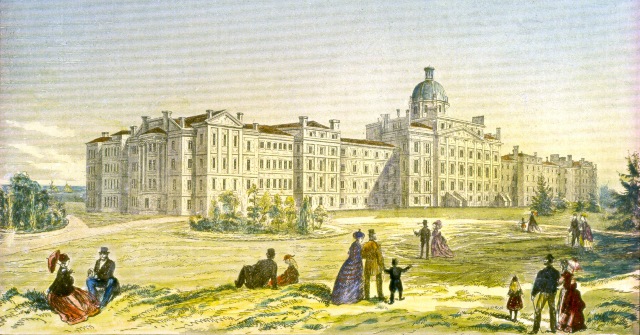
Another watercolour of the Provincial Lunatic Asylum.
At the time, the asylum was considered to be on the remote outskirts of the City, away from City residents who would travel to the area to look at the building as a tourist attraction.
On August 22, 1846, an official ceremony was held by provincial and civic officials for the laying of the cornerstone by the Honourable Chief Justice John Beverly Robinson.
Image of the top of the official program from the Laying of the Cornerstone event. To view the full official program, click on the image above.
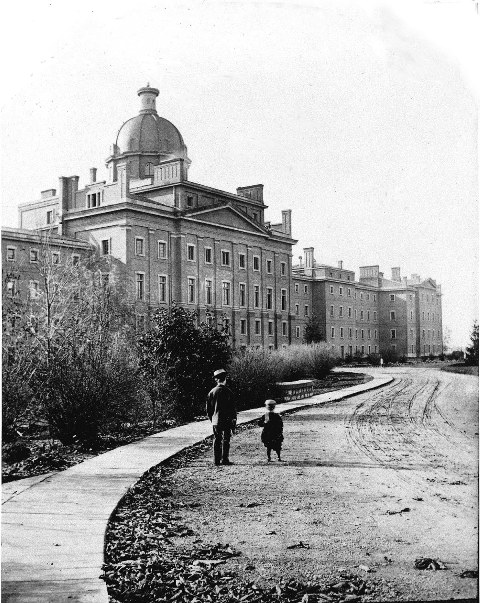
Three and a half years later on January 26, 1850, the Provincial Lunatic Asylum, with 250 beds, opened its doors to its first 211 patients who had been transferred from the Temporary Asylum, which was housed in a former jail on King Street. This photo was taken in 1868 by the Notman & Fraser Studio and is provided courtesy of the Toronto Reference Library, Baldwin Room.
At this time, there were few treatments available for patients with mental illness. There was, though, ‘Moral Therapy’, which included a lot of fresh air and work-related activities for patients, such as laundry, kitchen duties, and farming of the land.
Typically, patients wouldn’t get better – many of them would stay for life.
The Toronto architecture firm of Cumberland and Ridout was engaged in 1851 to design a wall with lodges and an entrance gate around the asylum. The half-height portion of wall between the lodges, fronting Queen Street West, had many decorative details, including an iron fence on top of the wall. And, a year later in 1852, an all-brick wall on the north, east, and west sides of the property was completed.
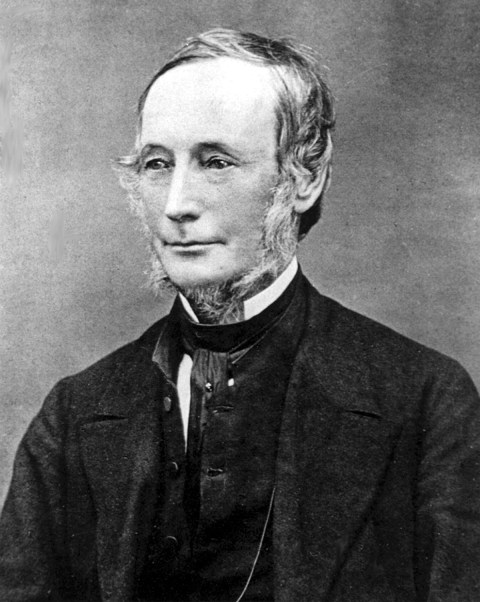
In 1853, Dr. Joseph Workman, an enlightened clinician and medical educator open to new ideas, came on board as the asylum’s Medical Superintendent, a role he held until 1875.
Dr. Joseph Workman
In 1860, Kivas Tully, renowned architect and civil engineer, prepared a new design for the wall, which included improved details such as stone capping; and a year later, the new south wall was complete. This new design survives today only along the south boundary.
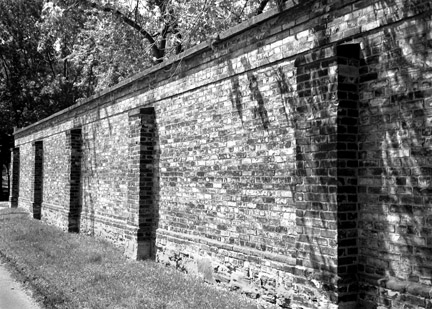
Patient labour was used extensively in the construction of the 12-16 foot surrounding walls, as well as subsequent reconstructions of the walls, large portions of which still remain standing today and are historically protected.
A photo of one of the historical walls.
Between 1866 and 1869, new east and west wings (also designed by Kivas Tully) were added to the main asylum building, almost tripling the bed capacity, as a measure to ease the severe overcrowding.
In 1871, the name of the asylum changed to ‘Asylum for the Insane, Toronto’, which held until 1905.
In 1878, a portion of the wall was demolished and replaced with an iron fence on Queen Street West to provide a view to the Superintendent’s Residence.
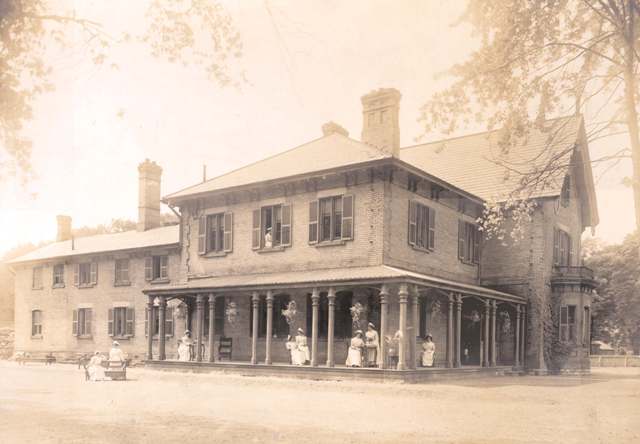
The Superintendent's Residence, circa 1906-1910, after its conversion to a Nurses' Residence.
Between 1888 and 1889, following the government’s sale of 23 acres of the site for development, the east and west walls were moved and rebuilt using original materials. All available limestone caps were reinstalled in these portions; however, there was not enough stone material to complete the wall to Queen Street.
This sale of land reduced the site to 27 acres, the size that it is today.
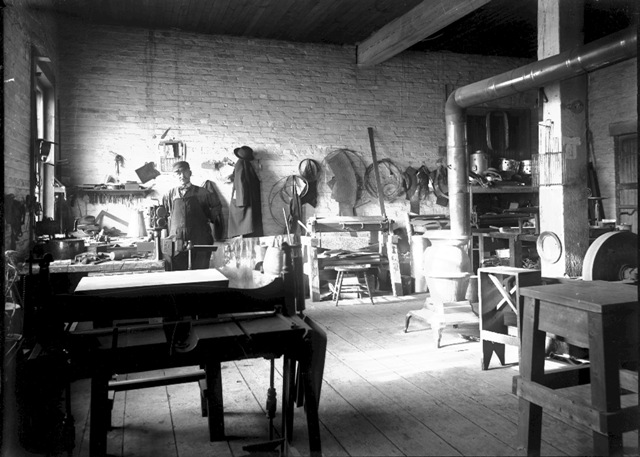
Then, in 1889, two new brick workshop buildings (extant) were constructed against the south wall for use by staff and patients engaged in several skilled trades. The buildings included the asylum carpenter’s shop, as well as the engineer’s, blacksmith’s, and painter’s shops.
Interior of one of the workshop buildings, circa 1906-1910.
In 1891, a new ‘Asylum for the Insane, Mimico’ opened as a branch of the Queen Street asylum, which soon became a fully-integrated provincial asylum in its own right.
For more history of CAMH and the Queen Street site: |
 Related Links |


|
Last updated: Jul 20, 2011 1:35 PM Published: Jun 10, 2019 4:13 AM ID#P59002 |